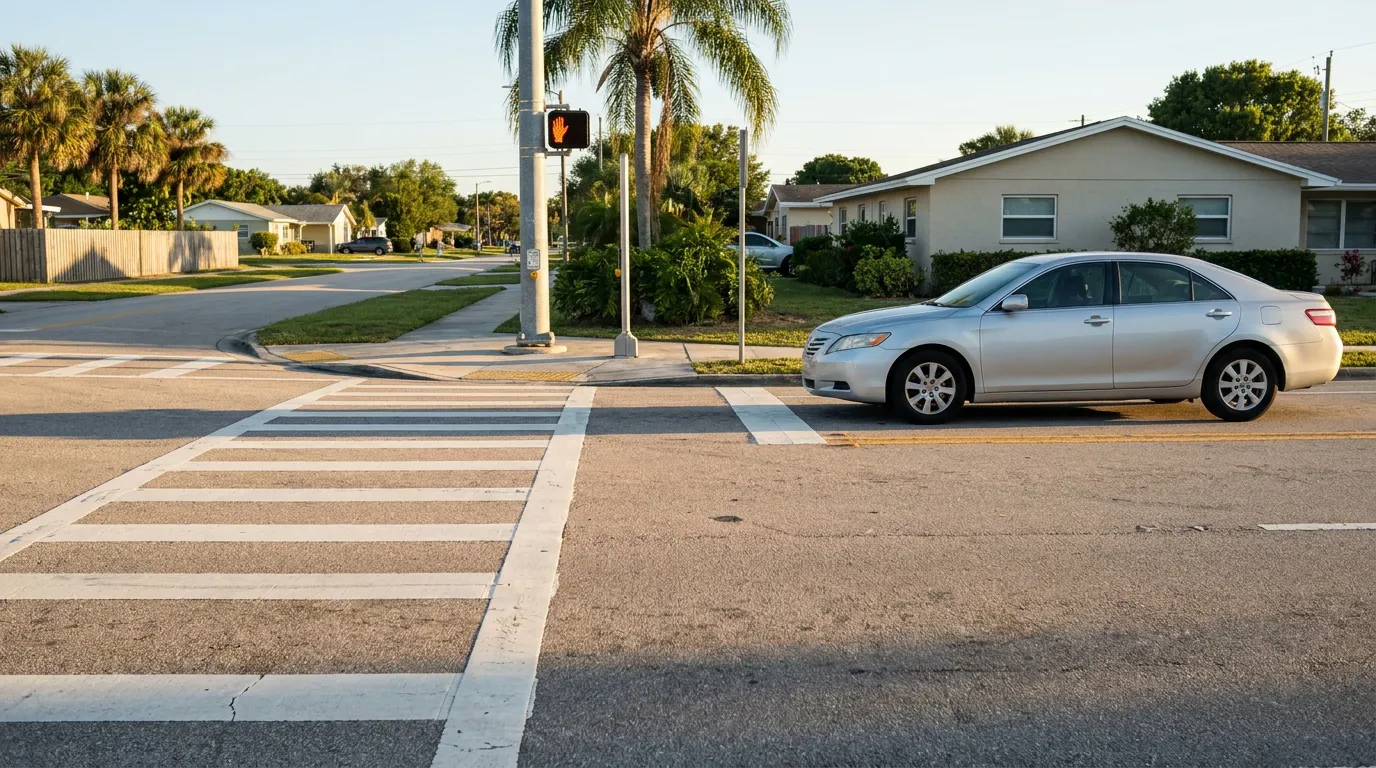
When a Sarasota Crosswalk Turns Into a Crisis
Key Takeaways: In Florida pedestrian crashes, liability typically falls on the negligent driver, though responsibility can be shared under the state’s comparative fault system. Drivers must yield to pedestrians under Fla. Stat. §316.130, and breaching this duty forms the basis for most claims. Pedestrians also carry statutory obligations, and violating them can reduce or bar recovery, particularly for crashes on or after March 24, 2023, when fault exceeding 50% eliminates compensation. Hit-and-run crashes are common and disproportionately harm pedestrians, but UM/UIM coverage may provide recovery when a driver flees. Strict filing deadlines make prompt legal review essential.
When a pedestrian is struck by a vehicle in Florida, liability usually falls on the driver whose negligence caused the crash, but responsibility can be shared under the state’s comparative fault system. A morning walk along a Sarasota corridor should never end in an emergency room, yet it happens far too often. Determining who pays depends on the crash facts, each person’s conduct, and specific Florida statutes.
At Greg Linehan Law, we believe injured pedestrians deserve straight answers from someone who has spent decades in the courtroom. If you or a loved one were hurt on foot, reach out to Greg Linehan Law for guidance, call our office at 941-559-4529, or request your free case review today.
How Florida Decides Who Is at Fault in a Pedestrian Crash
Florida assigns financial responsibility based on each party’s share of fault rather than making one defendant pay for everything. This distinction matters in pedestrian liability Florida analysis, because multiple people may have contributed to the collision. Courts examine the driver’s conduct, the pedestrian’s conduct, and any third parties before dividing responsibility.
Florida’s Comparative Fault Rule
Florida operates under a comparative fault model that limits a negligent party’s liability to that party’s own percentage of fault. Effective April 26, 2006, the legislature amended §768.81 to provide for apportionment of damages according to each party’s percentage of fault. The Florida Supreme Court has explained this doctrine prevents defendants from bearing liability for harm they did not cause.
Timing matters significantly: effective March 24, 2023, Florida moved from pure to modified comparative negligence, under which compensation is reduced by a person’s percentage of fault and recovery is completely barred once fault exceeds fifty percent. Any party found to be greater than 50 percent at fault for his or her own harm may not recover any damages, a change applying to actions filed on or after March 24, 2023, while earlier cases remain under the pure comparative negligence standard.
💡 Pro Tip: The date of your crash can affect which liability rule applies. Preserve documents showing exactly when and where the collision occurred, because timing may influence how fault and damages are apportioned.
When a Driver Breaches the Duty to Yield
Drivers owe pedestrians clear legal duties, and breaching those duties is often the starting point for proving driver negligence Florida claims. Under Florida’s pedestrian right-of-way statute, Fla. Stat. §316.130 requires drivers to stop and yield the right-of-way to pedestrians lawfully within a crosswalk. When a driver ignores this obligation and strikes someone lawfully crossing, that failure can establish strong liability.
A defendant driver may also plead and prove that a codefendant or nonparty caused some or all of the injuries, potentially reducing that driver’s share of responsibility.
Pedestrian Hit by Car: What to Do in Florida After Impact
Knowing pedestrian hit by car what to do in Florida can protect both your health and your legal claim. The moments after a collision are chaotic, but the steps you take can shape your case.
- Call 911 and seek medical care. Even minor symptoms can mask traumatic brain injury or internal trauma.
- Report the crash so an official record is created.
- Document the scene with photos of the roadway, signals, vehicle, and your injuries if able.
- Gather witness names and contact information before people leave.
- Preserve evidence such as damaged clothing, footwear, and nearby camera locations.
- Avoid recorded statements to insurers until you understand your rights.
💡 Pro Tip: Sarasota corridors often have traffic-signal and business surveillance cameras that overwrite footage within days. Acting quickly to identify those cameras can be critical to proving who is at fault pedestrian accident FL claims hinge on.
When the Pedestrian May Share the Blame
Florida law imposes duties on pedestrians too, and violating them can shift a percentage of fault onto the injured person. This does not automatically defeat a claim, but it can reduce recovery under the comparative fault framework and, for causes of action on or after March 24, 2023, eliminate recovery entirely if the pedestrian is found more than 50% at fault.
Several statutory duties commonly appear in litigation:
-
Fla. Stat. §316.130(1) requires pedestrians to obey official traffic control devices specifically applicable to them unless otherwise directed by police.
-
Fla. Stat. §316.130(3) prohibits pedestrians from walking on roadways paved for vehicular traffic where sidewalks are provided.
-
Fla. Stat. §316.130(4) requires pedestrians to walk on the left shoulder facing traffic where no sidewalk is available.
-
Fla. Stat. §316.130(8) prohibits pedestrians from suddenly leaving a curb or place of safety and walking or running into a vehicle’s path when it is impossible for the driver to yield, a provision applied in cases such as Rosenfeld v. Seltzer, 993 So. 2d 557 (Fla. 4th DCA 2008).
Whether any of these applies is highly fact-dependent. If you were struck in an unusual roadway setup, our discussion of pedestrian crashes in roundabouts explains how complex intersections complicate fault analysis.
💡 Pro Tip: Even if you believe you were partly at fault, you may still recover a portion of your damages. Do not assume a claim is worthless before an attorney reviews the full picture.
Recovering Damages After a Hit-and-Run Crash
Hit-and-run collisions are alarmingly common in Florida and create unique challenges for injured pedestrians. Nearly 25 percent of all crashes involve a hit-and-run.
In 2023, there were 104,273 hit-and-run crashes in Florida, resulting in 271 fatalities and 871 serious bodily injuries. Pedestrians bear a disproportionate share of that harm. Recent hit-and-run crash data shows that of the 271 hit-and-run fatalities in 2023, 159 were pedestrians and 47 were bicyclists, together accounting for 76% of hit-and-run fatalities.
Pursuing UM/UIM Coverage
When the at-fault driver flees or lacks insurance, uninsured and underinsured motorist coverage may become a critical source of recovery. UM/UIM benefits can compensate an injured pedestrian for medical costs and other losses when no liable driver can be identified or when that driver’s coverage is insufficient.
| Potentially Liable or Recovery Source | When It May Apply |
|---|---|
| Negligent driver | Failure to yield, distraction, or speeding |
| Third party or codefendant | Another vehicle or entity contributed to the crash |
| UM/UIM coverage | Driver flees or is uninsured/underinsured |
| Commercial or rideshare policy | Driver was working at the time of impact |
Meeting Florida’s Filing Deadline
Florida imposes strict time limits on filing a personal injury lawsuit, and missing them can bar recovery entirely. For negligence claims, Florida cut the statute of limitations from 4 years to 2 years for incidents occurring after March 24, 2023. Tolling or delayed-discovery arguments apply only in limited circumstances and are never automatic. Because a claim against a government vehicle can involve separate administrative notice requirements, prompt legal review is essential.
How Greg Linehan Law Advocates for Injured Pedestrians
Greg Linehan brings more than 26 years of trial experience to every pedestrian injury matter, working directly with clients rather than handing files to a rotating team. As a Sarasota firm with deep community roots, including service as President of Suncoast Charities for Children, we understand the corridors where these crashes happen. Greg has been recognized by 2025 Super Lawyers and the Florida Justice Association, reflecting a proven track record trusted by clients across the region.
Our team focuses on preserving evidence, proving causation, and holding negligent parties and insurers accountable. If you were hurt on foot, our page for a dedicated Sarasota pedestrian injury resource explains how we build these claims.
Frequently Asked Questions
1. Who is usually liable when a pedestrian is hit by a car in Florida?
Liability most often rests with the driver whose negligence caused the collision. However, under Florida’s comparative fault law, a negligent tortfeasor’s degree of liability is generally limited to his or her own degree of fault, so responsibility may be divided among multiple parties.
2. Can I still recover if I was partly at fault?
Yes, in many cases you can still recover a reduced amount. Florida apportions damages by percentage of fault, so sharing blame does not necessarily eliminate a Florida pedestrian claim. For crashes on or after March 24, 2023, victims who are found to be more than 50% at fault are barred from recovering any damages.
3. What if the driver fled the scene?
You may still have options through UM/UIM coverage. With nearly a quarter of Florida crashes involving a hit-and-run, these situations are common, and a pedestrian accident lawyer FL residents trust can help you explore available coverage.
4. How long do I have to file a claim?
Florida sets firm deadlines that courts enforce strictly. The specific limit depends on the parties and claim type, and exceptions are interpreted narrowly, so speaking with an attorney promptly helps protect your rights.
Protecting Your Recovery Starts With the Right Guidance
When a pedestrian is struck by a vehicle in Florida, liability turns on negligence, statutory duties, and the comparative fault framework that divides responsibility by percentage. Drivers owe clear duties to yield, pedestrians carry their own obligations, and hit-and-run crashes add layers of complexity that UM/UIM coverage may help resolve. Knowing pedestrian hit by car what to do in Florida, from preserving evidence to meeting deadlines, can make a meaningful difference in your case.
If you were injured, do not navigate insurers alone. Connect with Greg Linehan Law for your 100% free case review, call us directly at 941-559-4529, or contact our team now to discuss your options. We work on a contingency fee basis, so there are no upfront costs.
This blog is for informational purposes only and does not constitute legal advice. Contact Greg Linehan Law to discuss your specific case.