
Riding in the Back Seat in Sarasota: What Florida Law Actually Requires
Key Takeaways: Under Florida law, adult passengers age 18 or older are generally not required to wear a seat belt in the back seat, because § 316.614(5) applies the mandate to front seat occupants. Every occupant under 18 must generally be restrained in any seating position, and children 5 and younger fall under stricter rules in § 316.613. Seat belt violations are generally enforced as a primary offense, meaning an officer may stop and cite a vehicle for that violation alone. Special vehicles, including school buses and farm labor vehicles, carry their own belt requirements. Even when buckling up isn’t legally required, insurers often argue an unrestrained rear passenger contributed to their own injuries, and § 316.614(10) expressly allows non-use of an available belt to be considered as evidence of comparative negligence. Injured passengers should seek prompt medical care, preserve evidence, and speak with an attorney before their claim is valued.
You slide into the back seat of a friend’s car for a short ride down Fruitville Road, and nobody reaches for the belt. Under Florida’s current statutory text, an adult passenger age 18 or older riding in the back seat generally isn’t required to buckle up, because Fla. Stat. § 316.614(5) makes it unlawful "for any person 18 years of age or older to be a passenger in the front seat of a motor vehicle or an autocycle unless such person is restrained by a safety belt when the vehicle or autocycle is in motion." That said, persons under 18 are generally required to be restrained in any seating position, the statute contains exemptions for certain vehicles and occupants, and skipping the belt as an adult may still affect your injury claim later.
If you or a family member were hurt while riding as a passenger in Sarasota County, Greg Linehan Law offers a free case review. Call 941-559-4529 or reach our team online to talk directly with an attorney who has handled Florida crash claims for more than 26 years.
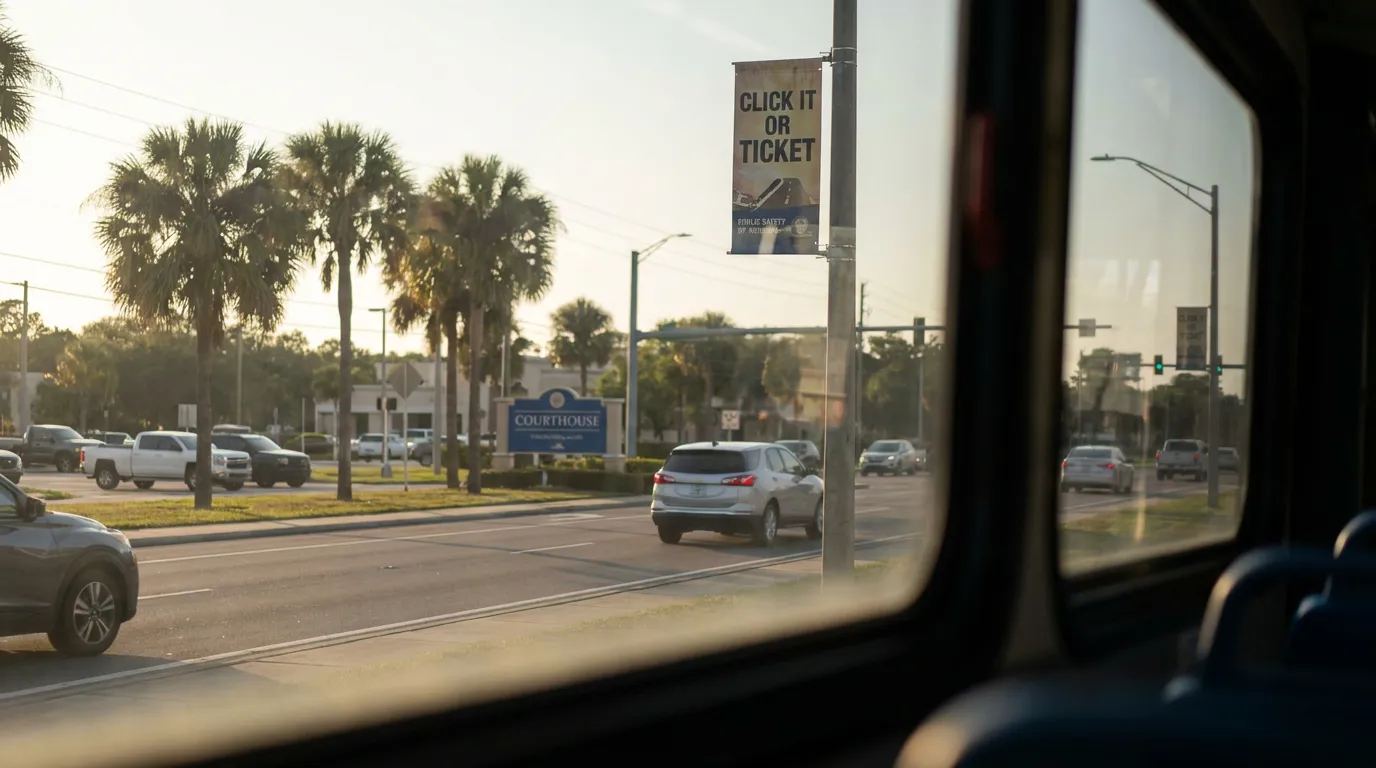
How the Florida Backseat Seat Belt Law Is Structured
Florida’s buckle-up rules live primarily in Chapter 316 of the Florida Statutes, and they are narrower than many drivers assume. The Florida Safety Belt Law generally requires the operator and all front seat passengers to be restrained, and separately makes it unlawful to operate a vehicle unless every passenger under 18 is restrained, regardless of seating position. The rear seat gap generally applies only to adults, in vehicles not otherwise covered by special rules.
Here is a practical breakdown of who is generally required to wear a seat belt in Florida:
- Drivers: generally required to be restrained while the vehicle is in motion.
- Front seat passengers of any age: generally required to be restrained under § 316.614(5).
- Passengers under 18: generally required to be restrained in the front or back seat.
- Children 5 and younger: subject to stricter child restraint rules under § 316.613.
- Adults 18 and older in the rear seat: generally not covered by the mandatory belt requirement, subject to exceptions.
Primary Enforcement Changes the Stakes
Florida generally treats seat belt violations as a primary offense for covered occupants. Since the Dori Slosberg Florida Safety Belt Law took effect in 2009, an officer may generally stop and cite a vehicle solely for an observed belt violation. Violations are generally nonmoving, though a child restraint violation under § 316.613 can carry points against the driver’s license. For families driving through Sarasota, that can make Florida seat belt compliance a real enforcement issue, particularly when minors are visible in the back seat.
Children Are Covered Differently and More Strictly
Florida’s child restraint statute generally applies no matter where the child sits. Under Fla. Stat. § 316.613(1), an operator transporting a child 5 years of age or younger is generally required to provide protection "by properly using a crash-tested, federally approved child restraint device," and for children through age 3 that device must generally be a separate carrier or a manufacturer’s integrated child seat. For children aged 4 through 5, the statute permits a separate carrier, integrated child seat, or booster seat, subject to limited exceptions allowing a properly used safety belt in certain circumstances, such as transportation by someone other than the parent or guardian, or documented medical necessity.
As a child ages out of a booster, the general requirement that occupants under 18 be restrained may take over, and the belt itself becomes the required restraint. Review the full framework in Chapter 316 traffic control statutes for exact language.
💡 Pro Tip: Photograph your child’s car seat and its installation after a crash before it’s discarded. Insurers frequently question restraint use, and contemporaneous images can help.
Special Vehicles With Their Own Passenger Seat Belt Rules
Some vehicles carry buckle-up obligations separate from the general passenger car statute. Under Fla. Stat. § 316.6145(2), each passenger on a school bus equipped with safety belts is generally required to wear a properly adjusted and fastened belt while the bus is in operation. That targeted requirement applies only to buses actually equipped with belts, showing the legislature knows how to reach non-front-seat occupants when it chooses to.
Florida also regulates farm labor vehicles. Under Fla. Stat. § 318.18(17), a one hundred dollar penalty may apply for a violation of § 316.622(3) or (4) when a vehicle fails to display a sticker authorizing it to transport migrant or seasonal farm workers, or fails to display standardized notification instructions requiring passengers to fasten their seat belts. This penalty addresses required stickers and notices rather than an individual passenger’s belt use, and is industry-specific, not a general rear seat belt requirement in Florida.
How Florida Compares to Other States
Seat belt laws vary considerably across the country in terms of seats covered, ages covered, and enforcement type. Some states have adopted all-passenger rear belt mandates, while others cover front seats only. Because legislatures revisit these statutes regularly, confirm current requirements rather than rely on outdated information.
| Coverage Category | Florida’s General Rule |
|---|---|
| Driver | Generally required |
| Front seat, 18+ | Generally required |
| Rear seat, 18+ | Generally not required |
| Any occupant under 18 | Generally required in any seat |
| Children 5 and under | Child restraint device generally required |
| Enforcement | Primary |
Why the Florida Backseat Seat Belt Law Still Affects Your Injury Claim
Not being legally required to buckle up isn’t the same as being protected when a claim is filed. The Florida Highway Safety and Motor Vehicles agency reports that seat belts substantially reduce the risk of fatal injury, an argument insurance adjusters often borrow when evaluating an unbelted passenger’s damages. Importantly, § 316.614(10) provides that a violation of the belt statute is not negligence per se and does not create a presumption of negligence, but that failure to use an available and operational safety belt may be considered as evidence of comparative negligence.
Florida applies a modified comparative negligence standard under § 768.81, as amended in 2023, and a claimant found more than 50 percent at fault for their own injury is generally barred from recovery in most negligence actions. Whether a belt-use argument actually reduces a rear passenger’s award is fact-dependent, and Florida courts generally require competent evidence that non-use caused or contributed to the specific injuries claimed. Our team treats this as a contested issue to be met with proof, not a concession.
What Passengers Should Do After a Sarasota Crash
Passengers often have a strong liability position among those involved in a collision, and they shouldn’t assume they lack options. Because Florida is a no-fault state, your own or the host driver’s PIP coverage typically responds first, and recovering noneconomic damages such as pain and suffering from an at-fault driver generally requires meeting the serious injury threshold in § 627.737. Working with a Sarasota car accident lawyer early may help preserve vehicle data, belt hardware, and witness accounts before they disappear.
Practical steps that tend to help:
- Seek medical evaluation promptly, as PIP benefits generally require initial care within 14 days of the crash.
- Request the crash report and note how restraint use was recorded.
- Preserve clothing, photographs, and the vehicle itself when possible.
- Decline recorded statements until you understand your rights.
- Document every missed shift and out-of-pocket expense.
💡 Pro Tip: Crash reports sometimes record restraint use incorrectly. If the report is wrong, raise it quickly rather than after the claim is valued.
Guidance Rooted in the Sarasota Community
Greg Linehan has practiced plaintiff-side injury law in this community for over 26 years, and clients work directly with him rather than being passed between departments. He has been selected to Super Lawyers in 2024, 2025, and 2026, recognized as a 2026 Lawyers of Distinction member, and named among SRQ Magazine’s 2026 Elite Top Attorneys, an honor nominated and voted on by local attorneys. The firm also earned a Bronze medal for Best Legal Firm in SRQ Magazine’s 2025 Best of SRQ Local awards.
Outside the office, Greg has served as President of Suncoast Charities for Children since 2020 and sits on the board of the Suncoast Foundation for Handicapped Children. Additional road safety and Florida injury topics are available in our Florida injury law articles.
Frequently Asked Questions
1. Can an adult be ticketed for riding unbelted in the back seat?
Generally, no, under the current text of § 316.614(5). The mandatory requirement generally reaches front seat occupants 18 and older and all occupants under 18. Enforcement outcomes can still depend on vehicle type and other applicable statutes.
2. Does the driver get cited if a minor in the back seat is unbelted?
In many situations, the operator may bear responsibility. Under § 316.614(4)(a) and § 316.613, Florida generally places the duty on the operator to ensure passengers under 18 are properly restrained, a common source of citations even when the driver is personally buckled.
3. Will not wearing a belt ruin my injury claim?
Not automatically, though it may be raised as a comparative fault argument. Belt non-use is not negligence per se in Florida, and whether it reduces recovery may depend on medical causation evidence and how a jury apportions responsibility. Outcomes vary by the facts of each case.
4. Do rideshare and taxi passengers have different rules?
The general statute may apply, but company policies and vehicle classification can change the analysis. Some commercial and for-hire vehicles may fall under separate provisions or exemptions. When in doubt, buckling up is the safer choice regardless of the legal minimum.
5. Has Florida’s rear seat rule changed recently?
Proposals to extend belt requirements to all rear occupants surface periodically in the Legislature. Because statutes can be amended, verify current requirements through Florida’s official buckle up guidance before relying on older summaries.
The Bottom Line for Back Seat Riders
Florida’s belt statute currently addresses adults in the front seat and minors in any seat, which generally leaves adult rear passengers outside the mandate while remaining physically vulnerable. Understanding the distinction between what the law requires and what an insurer may argue can affect whether a claim holds up or gets discounted. Every case turns on its own facts, medical records, and evidence.
If you were injured as a passenger anywhere in Sarasota County, get your 100% free case review from Greg Linehan Law. Call 941-559-4529 or start your free consultation today, and remember that we handle injury matters on a contingency fee basis with no upfront costs.
Disclaimer: This content is for informational purposes only and is not legal advice. Every case is unique, and results may vary. Consult an attorney about your specific circumstances.